Tuesday, 21 May 2013

SHINE RIGHT WITH THAT DIAMOND


One of my female friends asked if I could tell if on her engagement she could come to me and see if the ring she gets is a real diamond or not. So the first question I asked is "how sure are you’ll get engaged or get a diamond ring?"... Let’s just say I had to buy her lunch as an excuse of an apology.But anyway, away from my daftness, how would an ordinary Kenyan Republic citizenry, without the know-how , get to differentiate a genuine diamond from a fake? Well, fake or real, firstly you will need to get an actual/real Kenyan man who is willing to buy you a diamond ring, no matter how many carats it holds, which as I am told the number of carats increases with love, so I will have to explain carats later in another blog. I doubt women care anyway as long as its shinny and shaped just right. So back to the point. 


this stone has been graded both highest in colour and clarity grading – D colour and Flawless. The diamond was cut from a 236 carat rough diamond that was discovered at the Jwaneng Mine in Botswana. Because of the sheer size of the rough diamond and the intricacy of cutting this 101ct beauty, the stone took almost 2 years to polish

(http://www.77diamonds.com)
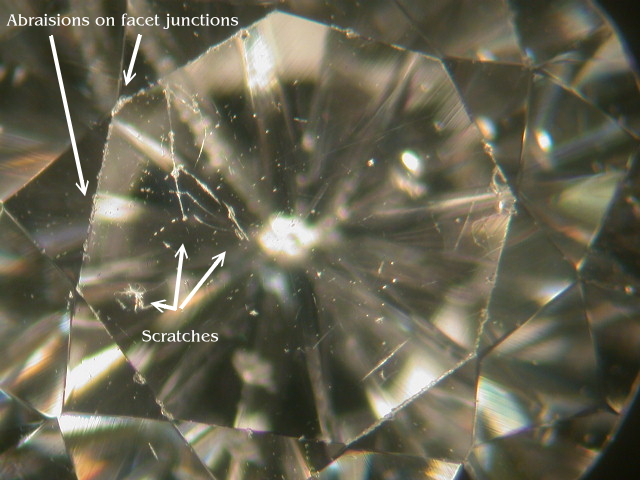
Diamonds- yes- The most popular diamond fake is a Cube Zirconia (C.Z for the purposes of this article).Thse ways listed here are not scientifically proven or fully effective but they could be of great help and are simple...somewhat.The oldest trick in the book is “all diamond scratches glass”. True. But so do every other fake in the black (ok I sometimes find this racist) market. C.Z scratches easily. 
This picture below shows abrasions at the facet junctions and scratches when looked at closely under a magnifying glass.


Fakes are also cut in a very sloppy manner most of the time. My advice then is use this with extreme care (meaning never)
My favorite has to be the fog test. Take the diamond place it in front of your mouth and just breathe on it. If the fog lasts for, lets say 2-4 seconds, congratulations your man is cheap! Diamond, releases heat instantaneously so the fog will have cleared up before you get to see it. (A downfall to this is that oil and dirt on the rock could affect its reliability)
For you who like having those kinky U.V lights in your bedrooms, you can use that light to do other things other than set the mood. When “doing your thing”-  because I know you probably have the ring on, and before it gets too exciting to notice- look at the diamond under the ultraviolet light, it should have a blue fluorescence. Most of the fakes usually don’t have it. Good for you if its real, but there is a twist too, it’s less valuable. I avoided saying cheap on this on this one. Lack of the blue fluorescence could mean its either a fake or of better quality. Two extremes in one.
The weight test. If you have a butcher husband, you would he would probably have a trophy cabinet of some of his prized measuring scales or whatever his fetish is. C.V will weigh 55% more than the real thing of the same shape and size. The fake diamond will then definitely tilt downwards towards itself in all its attention seeking.The next one if the most effective to some extent. 

The transparency test

Step one


Take a blank piece of paper and draw a dot on it with a pen


Step two


Take your “ice” turn it upside down on the paper and center it on the dot.


Step three

After its set and centered observe. The C.Z will have a circular reflection of the dot. The diamond will break up the reflection to a point where it becomes impossible to recognize


“I never worry about diets. The only carrots that interest me are the number of carats in a diamond.”
photo credits here

Tuesday, 7 May 2013

THANK YOU FOR VOTING!

Last Saturday, The RocKe Scientist was voted as the best environmental blog during the annual BAKE awards. I wish thank the fans, the voters and the sponsors for the award. Expect more earth science news, posts, FAQs, humour and more from RocKe Sci. Don't forget to share this page with your friends and help spread the messages. Science rocks.

Sunday, 21 April 2013

THE GREAT RIFTVALLEY [Gallery]

German photographer Michael Poliza took to the skies by helicopter to capture the extraordinary landscapes of the Rift Valley in Kenya and Ethiopia from the air. These images appear in his books Kenya and Eyes Over Africa
The Simien Mountains, Ethiopia A World Heritage Site and national park, with the tallest peak Ras Dashen reaching 4,619 metres, this region is best known as the habitat of Gelada baboons and Ethiopian wolves #
Lake Chamo One of the largest of Ethiopia’s Rift Valley lakes, the 213 square mile waters of Chamo are a sanctuary for several thousand Nile crocodiles, some reaching lengths of up to seven metres from their snout to the tip of their tail #
Flamingo Lake, Central Island, Lake Turkana, Kenya The region is home to hundreds of species of birds endemic to Kenya. They are essentially supported by plankton masses in the lake which feed the fish #
Lake Bogoria, Kenya This strongly alkaline, saline lake has an area of roughly 12 square miles. Many types of algae flourish in its waters, turning the lake a multitude of different shades. The algae-rich water is especially attractive to flamingos. When the water dries up during the hot season, the earth dries out and cracks #
Lake Borogia, Kenya A piece of abstract art created by hundreds of flamingos. In the dry season, the Eastern Rift Valley is a haven for these birds. The classic one-legged stance of these pink-plumaged birds actually protects them from the cold: two feet submerged in a lake results in losing more body heat than just one #
Nabiyotum Crater, Lake Turkana, Kenya"The first time I saw a photo of this crater, I just knew I had to go there," says Michael Poliza. "I was able to make it happen on my eight-week heli-Africa expedition, where I flew by helicopter from Hamburg to Cape Town, an expedition which provided material for my book Eyes Over Africa" #
Lake Turkana, Kenya Visiting fishermen ring the lake and stay for eight to 12 weeks, drying their catch in the sun to preserve it. The lake is home to tiger fish and Nile perch weighing up to 220 pounds #
Suguta Valley, Kenya A dune landscape with Aruba Rock visible in the background. Temperatures of up to 71C have been measured here. There are few other places on earth where so many different types of terrain can be found so close together – there are lakes, mountains, flood-plains and rich grasslands in close proximity to the dunes #
Suguta Valley Cloud formations and rain showers. "In this dry area near the Suguta Valley, rain is a very rare event. But when it does happen, it’s a good idea to keep your camera handy" #
Village near Lokwakangole, Kenya On the shores of Lake Turkana, woven palm-frond homes glow warmly in the afternoon light #

http://www.guardian.co.uk/travel/interactive/2013/apr/19/africa-rift-valley-ethiopia-kenya-gallery

Friday, 12 April 2013

Vote For The Best Environmental Blog in Kenya

The BAKE Kenyan Blog Awards are here with us again and we have had the privilege of being nominated as the best environmental blog. Let me first give a big thank you to all our dedicated followers and nominators.
Voting has been going on from 27th March and will go on until 1st May 2013. Kindly drop by at http://www.bloggers.or.ke/voting/ and vote for us [No. 5 in the list]. It is a minute-long process since it is simpler than the general elections.

Monday, 11 March 2013

HYDROCARBONS IN THE DEEP EARTH?


The oil and gas that fuels our homes and cars started out as living organisms that died, were compressed, and heated under heavy layers of sediments in the Earth's crust. Scientists have debated for years whether some of these hydrocarbons could also have been created deeper in the Earth and formed without organic matter. Now for the first time, scientists have found that ethane and heavier hydrocarbons can be synthesized under the pressure-temperature conditions of the upper mantle -the layer of Earth under the crust and on top of the core. The research was conducted by scientists at the Carnegie Institution's Geophysical Laboratory, with colleagues from Russia and Sweden, and is published in the July 26, advanced on-line issue of Nature Geoscience


Methane (CH4) is the main constituent of natural gas, while ethane (C2H6) is used as a petrochemical feedstock. Both of these hydrocarbons, and others associated with fuel, are called saturated hydrocarbons because they have simple, single bonds and are saturated with hydrogen. Using a diamond anvil cell and a laser heat source, the scientists first subjected methane to pressures exceeding 20 thousand times the atmospheric pressure at sea level and temperatures ranging from 1,300 F° to over 2,240 F°. These conditions mimic those found 40 to 95 miles deep inside the Earth. The methane reacted and formed ethane, propane, butane, molecular hydrogen, and graphite. The scientists then subjected ethane to the same conditions and it produced methane. The transformations suggest heavier hydrocarbons could exist deep down. The reversibility implies that the synthesis of saturated hydrocarbons is thermodynamically controlled and does not require organic matter.

The scientists ruled out the possibility that catalysts used as part of the experimental apparatus were at work, but they acknowledge that catalysts could be involved in the deep Earth with its mix of compounds.


-->

"We were intrigued by previous experiments and theoretical predictions," remarked Carnegie's Alexander Goncharov a coauthor. "Experiments reported some years ago subjected methane to high pressures and temperatures and found that heavier hydrocarbons formed from methane under very similar pressure and temperature conditions. However, the molecules could not be identified and a distribution was likely. We overcame this problem with our improved laser-heating technique where we could cook larger volumes more uniformly. And we found that methane can be produced from ethane."


The hydrocarbon products did not change for many hours, but the tell-tale chemical signatures began to fade after a few days.

Professor Kutcherov, a coauthor, put the finding into context: "The notion that hydrocarbons generated in the mantle migrate into the Earth's crust and contribute to oil-and-gas reservoirs was promoted in Russia and Ukraine many years ago. The synthesis and stability of the compounds studied here as well as heavier hydrocarbons over the full range of conditions within the Earth's mantle now need to be explored. In addition, the extent to which this 'reduced' carbon survives migration into the crust needs to be established (e.g., without being oxidized to CO2). These and related questions demonstrate the need for a new experimental and theoretical program to study the fate of carbon in the deep Earth."
Note: This story has been adapted from a news release issued by the Carnegie Institution


Read more : http://geology-page.blogspot.com/2011/09/hydrocarbons-in-deep-earth.html#ixzz2NFlS3BMO