One of my female friends asked if I could tell if on her engagement she could come to me and see if the ring she gets is a real diamond or not. So the first question I asked is "how sure are you’ll get engaged or get a diamond ring?"... Let’s just say I had to buy her lunch as an excuse of an apology.But anyway, away from my daftness, how would an ordinary Kenyan Republic citizenry, without the know-how , get to differentiate a genuine diamond from a fake? Well, fake or real, firstly you will need to get an actual/real Kenyan man who is willing to buy you a diamond ring, no matter how many carats it holds, which as I am told the number of carats increases with love, so I will have to explain carats later in another blog. I doubt women care anyway as long as its shinny and shaped just right. So back to the point.
 |
this stone has been graded both highest in colour and clarity grading – D colour and Flawless. The diamond was cut from a 236 carat rough diamond that was discovered at the Jwaneng Mine in Botswana. Because of the sheer size of the rough diamond and the intricacy of cutting this 101ct beauty, the stone took almost 2 years to polish (http://www.77diamonds.com) |
This picture below shows abrasions at the facet junctions and scratches when looked at closely under a magnifying glass.
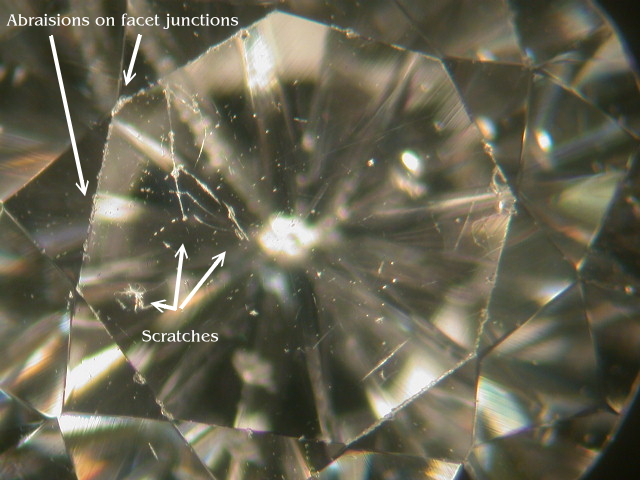
Fakes are also cut in a very sloppy manner most of the time. My advice then is use this with extreme care (meaning never)
My favorite has to be the fog test. Take the diamond place it in front of your mouth and just breathe on it. If the fog lasts for, lets say 2-4 seconds, congratulations your man is cheap! Diamond, releases heat instantaneously so the fog will have cleared up before you get to see it. (A downfall to this is that oil and dirt on the rock could affect its reliability)
For you who like having those kinky U.V lights in your bedrooms, you can use that light to do other things other than set the mood. When “doing your thing”- because I know you probably have the ring on, and before it gets too exciting to notice- look at the diamond under the ultraviolet light, it should have a blue fluorescence. Most of the fakes usually don’t have it. Good for you if its real, but there is a twist too, it’s less valuable. I avoided saying cheap on this on this one. Lack of the blue fluorescence could mean its either a fake or of better quality. Two extremes in one.
The weight test. If you have a butcher husband, you would he would probably have a trophy cabinet of some of his prized measuring scales or whatever his fetish is. C.V will weigh 55% more than the real thing of the same shape and size. The fake diamond will then definitely tilt downwards towards itself in all its attention seeking.The next one if the most effective to some extent.
The transparency test
Step one
Take a blank piece of paper and draw a dot on it with a pen

Step two
Take your “ice” turn it upside down on the paper and center it on the dot.

Step three
After its set and centered observe. The C.Z will have a circular reflection of the dot. The diamond will break up the reflection to a point where it becomes impossible to recognize

“I never worry about diets. The only carrots that interest me are the number of carats in a diamond.”
photo credits here

Step three
After its set and centered observe. The C.Z will have a circular reflection of the dot. The diamond will break up the reflection to a point where it becomes impossible to recognize

“I never worry about diets. The only carrots that interest me are the number of carats in a diamond.”
photo credits here

