Kenya has struck its first substantive natural gas deposits near Malindi, further raising its profile as a potential oil and gas exporter.
An Australian oil prospecting company Pancontinental involved in drilling off the Kenyan coast said Monday morning it has encountered approximately 52 net metres (about 170 feet) of natural gas pay so far.
The firm says it struck the gas at the Mbawa deep-water well.
By PAUL WAFULA pwafula@ke.nationmedia.com
“The Mbawa 1 well has encountered approximately 52 net metres (approx. 170 feet) of natural gas pay in porous Cretaceous sandstones. The Mbawa 1 exploration well was drilled to a depth of 2,553m RT (below the drill floor), at which point wireline logs, fluid samples and sidewall cores were acquired from the well,” said Mr Barry Rushworth, Pancontinental Chief Executive and Director said in a statement.
The firm said the reservoir and fluid parameters will become available as logs and sample analyses are completed.
It says it has resumed drilling targeting 3,275 metres.
“While we have not finished operations in Mbawa 1, this gas discovery is very promising and it is the first ever substantive hydrocarbon discovery offshore Kenya. We are delighted to prove that there is a working hydrocarbon system offshore Kenya,” Mr Rushworth said.
The firm said further work continues to evaluate the size of the discovery.
“With drilling continuing to a deeper exploration target, these interim results may be the first part of the story in this well, and they are certainly just the beginning of the main story of oil and gas exploration offshore Kenya,” Mr Rushworth said.
The discovery comes at a time when Kenya has already struck oil and is waiting for further analysis to confirm if it the quantities are commercially viable.
15 years ago ask any typical Kenyan what minerals Kenya had and the only three minerals that popped up were soda ash, diatomite and fluorspar. Blame it on KIE syllabus and our geography teachers. Fast forward to 2012 and Turkana oil will be the first mineral that comes to mind with coal in Kitui coming a close second this time the media hype being to blame! Finally Kenya had ‘landed’ into the lucrative oil business and a possible European style industrial revolution being envisioned in the near future.
With both resources far from exploitation this might take a while and with the fragile state of political affairs vision 2030 might become a 22nd century achievement.
Since independence the Kenyan mineral industry has been dominated by non-metallic minerals with Magadi Soda, Kerio Valley Flourspar, Kariandusi Diatomite and tsavo gemstones (tsavorite) being our most notable resources. Kisii soap stone (which are pumice rocks) has also been a revenue generator in the Western Kenya County. Sculptures begun sculpting the rocks into various characters based on the famous American dysfunctional cartoon family The Simpsons and started exporting their ''Simpson soapstone'' products (Check out a story about it here ) and even more recently started a day in which people displayed their products, ingenious but simple way of marketing themselves!
(pictures courtesy of craftvillageuk.com)
Another undocumented but readily available resource is Carbon Dioxide. This might not come to mind as your basic mineral resource but it has been mined by Carbacid ltd at a mine in Keraita and they have been the major suppliers of extinguishers in the country.
Pockets of gold mines in West Kenya have been death traps for many residents in these areas but significant efforts have been taken to mine in large scale. Magadi soda is probably the only mineral, and Kenyan product that every Kenyan has used!! The salt produced from the lake has been to every Kenyan plate since it hit the markets back in the day. From Athi river mining, Bamburi Cement and East Africa Portland, these companies have taken advantage of the housing boom that has hit Kenya over the last 10 years to double their production of the enormous deposits of limestone in Athi river and the coast which account to 4% of world production. Tiomin Resources Inc. of Canada has planned to produce 330,000 t/yr of ilmenite, 75,000 t/yr of zircon at Kwale.Why are these minerals important? Because they are used in almost every electronic we use meaning demand over the years has pushed their prices even higher. Also in the same category is the mineral pyrochlore found in Mrima Hill also near the coast.
Mrima Hill (pics from mrimahill.com )
The pyrochlore has economic amounts of niobium but with the small amounts of radioactivity from the hill, and with its status as a forest reserve and heritage site mining is yet to begin. Of the Kenya occurrences, that of Mrima has received the most attention and is potentially of greatest importance. Its proximity to the port of Mombasa, the size of the deposit, low mining costs and presence of other commercially interesting minerals could make this one of Kenya’s most important resource (read more about it here)
This list is far from complete. We have many other minerals being explored for and others already being mined in small scale but that’s a story for another day.
Ludwig Krapf, was the 1st European to see Mt Kenya. It was on the 3rd day of December in the year of the lord 1849 A.D. together with Another European Rebmann, was also the first to see Mt Kilimanjaro , they went back to Europe to a critical reception from their peers. They claimed that what they say were not snow capped mountains but calcareous earth. Krapf’s claim was confirmed in 1887 by fellow explorer Joseph Thomson when he saw the mountain from the Laikipia plateau, and described it as an eroded remnant of the old volcano, the peak being ‘’……the column of lava which closed the volcanic life of the mountain….”. the 1st ascent to the upper part of the mountain was made in 1887 by Count Teleki, who reached an altitude of approximately 13800 feet in the Teleki valley. The summit of Mt. Kenya was climbed for the first time by H. J. Mackinder and two Alpine guides on September 13th 1899.
The mountain itself a volcanic pile consisting of Precambrian age Trachytes, Basalts, Phonolites,Kenytes, Rhomb porphyries. From your high school geography you probably know it’s a composite volcano and for those who avoided geography then now you know. Its plug is composed of nepheline syenite and phonolite in ring structure. Here are some of the peaks and their respective heights in meters
Batian 5199m, Nelion 5188m, Point Lenana 4985m, Point Pigott 4957m, Point Thomson and Thomson Flake 4955m, Point Dutton 4885m, Point Melhuish 4880m, Point John 4863m, Point Peter 4757m, Midget peak 4700m.
Photos courtesy of John Jammin
Rough route overlay of the Normal Route on Nelion, with key
features marked.
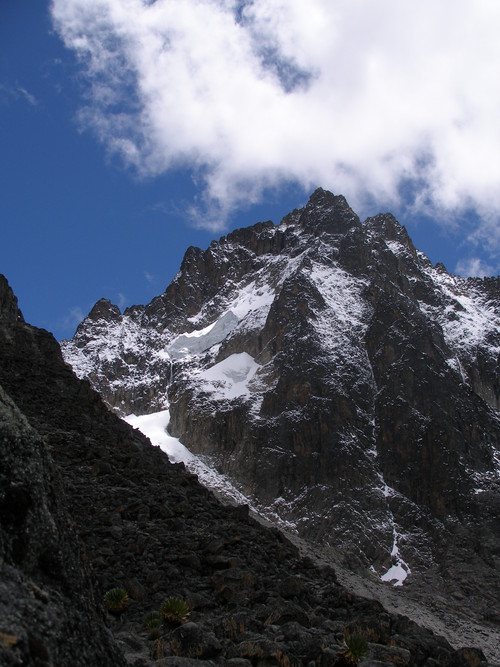
Mount Kenya as seen from the Hall Tarns on the Chogoria
route. Point Lenana is on the left hand side and the twin summits of Nelion and
Batian are on the right.
South side of Mount Kenya as seen from the head of the
Teleki valley. Batian and Nelion are the twin summits and Point John in the right forground.
There is a fire that has been burning for 50 years straight! According to Thinking Blog in May 1962, Centralia Town, Pennsylvania, United States, the town council sends some volunteer firemen to an abandoned mine pit to clear the towns landfill.
The firemen did what they always did in the past, set fire to the dump and let it burn for some time then they eventually put it off. They did put it off but the fire wasn’t completely extinguished. The fire started burning below the surface, spread through a hole in the rock pit into the abandoned coal mines that lay below the town. They tried to put it out but nothing worked.
But it was in 1981 when it became national news. A young boy 12 years old fell into a 45 meter sink hole that caved beneath his feet. He was saved by his cousin before he could plunge even further to his death. 3 years later the American government allocated 42 million to relocate the 1000 residents of Centalia and today only 9 people currently reside in the town.
Brian Merchant in his blog in Treehugger says that the fire is has now burned over an area of over 500 acres and over the next 100 years could spread to an area of 3700 acres.
These fires are not easy to control with countless other products being burned together with the coal and the greenhouse gasses including methane being released. I know your minds probably swayed to the Mui coal mine in Kitui but am sure the relevant safety have been addressed there by the Kenyan government and all concerned or so we think they have!
photos courtesy of thethinkingblog
One of my former lecturers once told me that the Constitution was arranged in order of importance and I tended to agree with him.
“Chapter one: sovereignty of the people and supremacy of this constitution’’ being the most important chapter in the constitution, as this Republic is built on our Sovereignty as Kenyans first then as every tribal, political and economic groupings that we impose upon ourselves “All sovereign power belongs to the people of Kenya and shall be exercised only in accordance with this Constitution” being the most important statement in the chapter. The second in importance is “Chapter two: The Republic” whose territory we are expected to protect as citizenry or government. “Chapter three: Citizenship” defines what makes us Kenyans first before we go on to become Dujis Mijikenda and Borana. “Chapter four: The Bill Of Rights” outlines what former governments ignored as the atrocities we witnessed before independence were being repeated seemingly forgetting what we went through to become the independent republic we are now. And again Part 2 is also arranged in order of importance with the most basic and most fundamental right, the right to life being top of the pile.
From there henceforth the rest of the constitution tries to deal with the various issues that have been considered contentious for a long time. This is not to say that they are any less important, but what defines this beautiful country and its people are found in these 4 chapters. The executive which comes way down in Chapter 9 shows you how much, the minds behind the constitution look at one of the unholy trinity that is the government. So before we go out to ‘fight’ for our ‘man’ or ‘woman’ ask yourself how important that is.
As scientists we have however not been left behind in this new dispensation and our importance is outlined in a small article in Chapter 2. Chapter 2 article 11 states:
•(1) This Constitution recognises culture as the foundation of the nation and as the cumulative civilization of the Kenyan people and nation.
•(2)The State shall—
a.Promote all forms of national and cultural expression through literature, the arts, traditional celebrations, science, communication, information, mass media, publication, libraries and other cultural heritage;
b.Recognise the role of science and indigenous technologies in the development of the nation; and
c.Promote the intellectual property rights of the people of Kenya.
•(3)Parliament shall enact legislation to-
a.Ensure that communities receive compensation or royalties for the use of their cultures and cultural heritage; and
b.Recognise and protect the ownership of indigenous seeds and plant varieties, their genetic and diverse characteristics and their use by the communities of Kenya.
From that plane made of a car engine to the banana tissue culture we have to protect what we invent.
Universities and research institutions spend a lot of money in research and the findings they obtain are sometimes taken by foreigners changed and published as original works by them without recognising any of our scientists’ effort. Most of our geological maps and reports were done by foreigners from as far as the 1890’s when Gregory, J. W. who wrote about “Contributions to the Physical Geography of British East Africa” in 1894 and a follow up on “the Geology of Mt Kenya” back in 1900. Of importance is that these old reports all mentioned something about some of these important minerals that we are rushing to claim ‘we’ve discovered’. All it needed was someone to look at the fine print and that’s why we have so many foreigners looking for these minerals instead of our local scientists. The blame is obviously on us as geologists I must admit. Our focus must thus shift from just writing research papers for publishing in important foreign journals for international recognition and to the dirt that these important minerals and resources are hidden. Going by recent major findings were getting to where we need to be. Of particular praise should be those in the geothermal fields. The government has tried so hard to ensure that this resource is fully Kenyan with finance being the only foreign input into the various geothermal projects. The new constitution provides us with an opportunity for recognition as well as innovation. As Kenyans we have fabulous ideas. From M-pesa to Ushahidi on the global scale to the very local solar lamps and energy saving stoves we are very much an innovative population.
When the kiondo was patented by the Japanese it became clear that something had to be done to prevent such a scenario occurring again. Our local universities should be at the forefront of doing this with all the creative ideas being churned out by its students but they should also ensure that they recognise the effort of the creators and adequate compensation is necessary to them. Technology cannot be separated from science as stated in the constitution and both should go hand in hand as this is the only way the science family proves its viability to the rest of the world.